Most Popular Posts of All Time

Monday, March 21, 2011

2nd Follow-Up Posting on the Correlation Between Basketball Team Assists and Game Results

This 2nd follow-up posting follows the 1st Follow-Up Posting on the Correlation Between Basketball Team Assists and Game Results for NCAA and NIT championship tournament basketball games. Prior to this 2nd follow-up posting, the team that led in assists had won 42 games and lost only 8 games with three games where assists were tied. That stat can now as follows be summed to 55 won and 13 games lost by the team that led in assists with 4 games tied in assists.

Further NCAA Division I championship tournament games (the team that led in assists won 11 games, lost 4, with 1 game tied in assists)
  • Richmond beat Morehead State 65-48 and the Spiders also led in assists 18-7 (recall that Eagles had only 11 assists in upsetting Louisville and we predicted they would lose this game)
  • Connecticut beat Cincinnati 69-58 but trailed in assists 12-10 as Kemba Walker scored 33 points with 5 assists for the Huskies and Uconn won the game at the foul line making 25-30 free throws to only 10-14 for the Bearcats (recall that Cincinnati trailed in assists in beating Missouri and we predicted they would lose this game)
  • San Diego State beat Temple 71-64 in 2 overtimes and the game was tied in assists 13-13 (recall that the Owls trailed in assists 12-10 in beating Penn State and we predicted they would lose this game)
  • Kentucky beat West Virginia 71-63 and led in assists 12-9
  • BYU beat Gonzaga 89-67 but trailed in assists 18-17 as Jimmer Fredette scored 34 points with 6 assists for the Cougars, who won the game on long distance shooting, canning an uncanny 14 of 28 3-point shots, i.e. 42 points on 3-pointers !
  • Florida beat UCLA 73-65 and led in assists 13-12 (recall that the Bruins trailed in assists 13-20 in beating Michigan State and we predicted they would lose this game)
  • Butler beat Pittsburgh 71-70 but trailed in assists 21-12 as the Bulldogs beat the Panthers via 12 of 27 3-point field goals, among other things
  • Wisconsin beat Kansas State 70-65 and led in assists 12-7 as Wildcat guard Jacob Pullen scored 38 points, but the Badgers won the game mostly at the free-throw line on 19 of 23 conversions to only 15 of 22 for K-State, which befits the Wisconsin record of being the best free-throw shooting team in the country this season, currently at 82.3%, which would break the Harvard NCAA record of 82.2% set in 1984
  • Kansas beat Illinois 73-59 and led in assists 17-16
  • Florida State beat Notre Dame 71-57 and led in assists 15-12 as the Fighting Irish converted only 7- of 30 3-point shots and 8 of 32 inside field goals
  • VCU beat Purdue 94-76 and led in assists 26-20 (!) as both teams played strong team basketball with VCU winning the accuracy match with a 57% to 45% FG percentage
  • Duke beat Michigan 73-71 but trailed in assists 13-12
  • Arizona beat Texas 70-69 and led in assists 17-13 as freshman Jordin Mayes was the difference in 19 minutes of play with a season-high of 16 points, 6 of 7 field goals, of which 4 of 4 were 3-pointers (his season average is 46% and if he plays more than 19 minutes in upcoming games, look out for Arizona)
  • North Carolina beat Washington 86-83 and led in assists 18-17 as Tar Heel freshman guard Kendall Marshall had 14 of those assists (!)
  • Ohio State beat George Mason 98-66, even after falling behind early 11-2, and led in assists 23-13, 15 of those by freshman guard Aaron Craft off the bench, as the Buckeyes made 61% of all field goals, including not only 16 of 26 from 3-point range but 7 of 7 3's by the game's leading scorer, 6'5" senior David Lighty
  • Marquette beat Syracuse 66-62 and led in assists 15-11
Further NIT championship tournament games  (thus far 2 of 3)
  • Kent State beat Fairfield 72-68 but trailed in assists 16-12
  • Wichita State beat Virginia Tech 79-76 in overtime and led in assists 18-10 (who is going to beat the Shockers in the NIT tourney?)
  • College of Charleston beat Cleveland State 64-56 and led in assists 15-9  
  • Northwestern beat Boston College 85-67 and led in assists 27-13

Saturday, March 19, 2011

Follow-Up Posting on the Correlation Between Basketball Team Assists and Game Results

The team that led in assists won 14 games and lost 5 games with 1 game tied in assists in NCAA Division I competition. IN the NIT the data thus far was 12 games won by the team that led in assists, 2 tied, and only 2 lost.

Here is an update, including the last 16 NCAA tournament games in the Round of 64 and 1 NIT game. The team that led in assists won 16 of 17 games so that in 53 games, the team that led in assists won 42 games and lost only 8 games with three games where assists were tied (Won-Tied-Loss 14-1-5, 12-2-2, 16-0-1)

  • George Mason beat Villanova 61-57 and led in assists 12-10
  • Ohio State beat UTSA 75-46 and led in assists 26-6 (amazing stat!)
  • North Carolina beat Long Island 102-87 and led in assists 21-19 (hats off to the Blackbirds for a game well played and won by the Tar Heels only on the boards and at the free throw line)
  • Marquette beat Xavier 66-55 and led in assists 13-11
  • Washington beat Georgia 68-65 and led in assists 10-9
  • Syracuse beat Indiana State 77-60 and led in assists 17-13
  • Notre Dame beat Akron 69-56 and led in assists 16-10 and that was a good thing because the Fighting Irish otherwise won the game only at the free throw stripe as Akron actually made more baskets
  • Florida State beat Texas A&M 57-50 and led in assists 14-12
  • Kansas beat Boston University 72-53 and led in assists 19-10 (recall that KU ranked 2nd nationally on this stat in the regular season)
  • Purdue beat St. Peter's 65-43 and led in assists 12-9
  • Illinois beat UNLV 73-62 and led in assists 21-10
  • VCU beat Georgetown 74-56 and led in assists 14-12
  • Texas beat Oakland 85-81 and led in assists 14-12
  • Michigan beat Tennessee 75-45 and led in assists 20-10
  • Arizona beat Memphis 77-75 but trailed in assists 16-11 (this indicates to us that Arizona probably will not go far in the tournament)
  • Duke beat Hampton 87-45 and led in assists 17-4 (the Pirates forgot about team play)
In the NIT, Colorado beat Cal 89-72 and led in assists 13-12 (that stat is still a bit weak for the Buffaloes, but they are making great strides forward under first year head coach Tad Boyle)

Friday, March 18, 2011

Kansas Led NCAA Basketball Division I Teams in Assists During the Regular Season: It's a Team Game and The Team with the Most Assists Usually Wins

Which NCAA Division I basketball team led the nation in average assists per game during the regular season 2010-2011?

The answer is currently 2nd-ranked Kansas: 17.9 assists per game.

We noticed some years back that one of the most important statistics in college basketball besides the final score is the total assists stat.

Basketball is at its core a team game and the team with the most assists usually wins. Of course, a stronger team is likely to have more assists just because of the strength of its players and because it scores more baskets, but a strong team without a good team game will likely lose to an equally strong team -- or even a somewhat weaker team in terms of personnel -- that has a better team game.

Let's take a look at the box score stats of all the NCAA Division I tournament games thus far as an example:
  • Clemson beat UAB 70-52 and led in assists 17-10
  • N.C. Asheville beat AR Little Rock 81-77 in OT but trailed in assists 19-17 (we think AR Little Rock would/should have won this game had their star Solomon Bozeman not fouled out prior to overtime)
  • VCU beat USC 59-46 and led in assists 11-4 (very poor team play at USC)
  • UTSA beat Alabama State 70-61 and led in assists 14-13
  • West Virginia beat Clemson 84-76 and tied in assists 15-15
  • Kentucky beat Princeton 59-57 and led in assists 12-8
  • Butler beat Old Dominion 60-58 and led in assists 11-8
  • Pittsburgh beat N.C. Asheville 74-51 and led in assists 18-9 (sophomore Travon Woodall was in the game for only 23 minutes and had 6 assists (!) but was only 1 for 6 himself on field goals, so let him play but not shoot)
  • Florida beat UCSB 79-51 and led in assists 22-8 (6'10" forward (!) Chandler Parsons had 10 assists)
  • BYU beat Wofford 74-66 and led in assists 14-8 (Jimmer Fredette not only scored 32 points but led all players in assists with 7)
  • Wisconsin beat Belmont 72-58 and led in assists 13-12
  • UCLA, record national champion, beat Michigan State, also a perennial powerhouse when it comes to NCAA tournaments, 78-76, but was lucky to win, trailing in assists 13-20, and winning the rough game only at the free throw line with 30 of 47 foul shots to only 16 of 21 for Michigan State
  • Gonzaga beat St. John's 86-71 and led in assists 20-9
  • Kansas State beat Utah State 73-68 and led in assists 14-10
  • Morehead State beat Louisville 62-61 but trailed in assists 14-11
  • Richmond beat Vanderbilt 69-66 and led in assists 14-12
  • Temple beat Penn State 66-64 but trailed in assists 12-10
  • San Diego State beat Northern Colorado 68-50 and led in assists 11-8
  • Connecticut beat Bucknell 81-52 and led in assists 20-6 (Kemba Walker led all scorers with 18 points AND 12 assists -- that is player dominance)
  • Cincinnati beat Missouri 78-63 but trailed in assists 15-14
In 20 games thus far, the team that led in assists won 14 of those games, tied in assists in 1, and lost 5, and even if a game was lost, the stats were close, except in one game only which was decided by free throws, i.e. where assists and field goals played a secondary role.

So, how useful is this information?

We expect ALL of the teams that won in the Round of 64 but had fewer assists than their opponents to LOSE in the Round of 32 (i.e. UCLA, Morehead State, Temple and Cincinnati).

Similarly, we expect teams with a large dominance of assists to be especially strong in the coming round(s) (i.e. Pittsburgh, Florida, Connecticut), because the number of assists points to their strong TEAM game. Both Gonzaga and BYU also did well in terms of assists but they play each other in the Round of 32 and so one of them must fall. (The big difference for Gonzaga in their recent win streak is 6'4" guard junior Marquise Carter, moved by Coach Mark Few from point to off guard, who is strong defensively, and who scored 24 points against St. John's, and also had 6 assists AND 6 rebounds for the Bulldogs -- that's All-American play. Indeed, Carter was an NJCAA All-American. Ever since Carter was moved into the starting lineup 10 games ago, and has been playing 30 minutes or more per game, Gonzaga has been winning impressively. Early in the season, e.g. in the Bulldogs worst loss, 81-59 to Washington State, Carter was not even in the starting line-up and scored 0 points.)

Logically, if a winning team has only a so-so performance on assists this may indicate that those teams may be over-rated. San Diego State, for example, which was not impressive at all in its game, may be one of those over-rated teams.

Just as a check on the theory, a look at the NIT games thus far shows that the team that led in assists won 12 of 16 games thus far in the tournament, tied in assists in 2, and lost only 2:

NIT Tournament First Round
  • Alabama beat Coastal Carolina 68-44 and led in assists 12-7
  • New Mexico beat UTEP 69-57 and led in assists 16-13 
  • Missouri State beat Murray State 89-76 and tied in assists 16-16
  • Miami of Florida beat Florida Atlantic 85-62 and led in assists 11-6
  • Colorado beat Texas Southern 88-74 and led in assists 19-14
  • California beat Mississippi 77-74 and led in assists 17-11
  • Fairfield beat Colorado State 62-60 and led in assists 14-11
  • Kent State beat St. Mary's 71-70 and trailed in assists 17-13
  • Boston College beat McNeese State 82-64 and led in assists 17-10
  • Northwestern beat Wisconsin-Milwaukee 70-61 and led in assists 17-16
  • Oklahoma State beat Harvard 71-54 but trailed in assists 13-9
  • Washington State beat Long Beach State 85-74 and led in assists 17-12
  • Virginia Tech beat Bethune-Cookman 79-54 and led in assists 21-13
  • Wichita State beat Nebraska 76-49 and led in assists 18-6 (as a Husker alum I can say that the coaching of the Cornhuskers basketball team is badly in need of improvement or change, given that disastrous statistic - the worst in all of the NCAA and NIT games thus far, showing virtually no team game at all. The NU coach blamed the loss on poor shooting, but that is just the tip of the iceberg for a coach who preaches defense but does not seem to understand how to generate team offense).
  • College of Charleston beat Dayton 94-84 and tied in assists 11-11
  • Cleveland State beat Vermont 63-60 and led in assists 16-10

Tuesday, February 01, 2011

The Publicly Owned Green Bay Packers: A Model for Professional Sports ?

We have been Steeler fans for many years but if the Green Bay Packers should win the upcoming Super Bowl, they would, in a sense, be the "people's" champion.

Patrick Hruby has a great article at ESPN.com on the unusual status of the publicly owned Green Bay Packers in professional football at
Super Bowl: The publicly owned Green Bay Packers could be the model for a better way to organize and administer professional sports. - ESPN

Wednesday, October 07, 2009

The Best College Football Teams of All Time Can Be Narrowed Down Using NAYPPA - Net Average Yards Per Play Advantage

Numerous sources have tried to pin down the best college football teams of all time. Obviously, almost any method of determining the relative strength of teams over the years entails subjective judgments, since teams can not play each other and because the quality of football changes over time via new strategy and tactics, new systems, new training methods, etc.

However, there is one fairly objective measure available of the relative strength of football teams which is fairly constant each season and which in recent years hovers around a median for all teams of about 5.4 to 5.5 yards per play on offense and the same amount defense, i.e. a net of zero. This statistic is NAYPPA - an acronym coined by Andis Kaulins - for the Net Average Yards Per Play Advantage, or, simply put, how many yards per play MORE did a team gain on offense the entire season than the yards per play which the defense allowed in that same football season. This shows the dominance of any team in a particular season of play.

This simple method, which can be tweaked for even more accuracy by meshing it with the strength of schedule, has over the past several football seasons proven superior to the polls and many other statistical methods used for judging the strength of a team.

When we view past national college football champions, NAYPPA immediately brings to the fore those very teams that others have ranked as great using other methods of comparison (W-L record, margin of victory and other statistical parameters, the number of All-Americans, the number of subsequent first round draft picks, the subsequent number of pro players, etc.)

The team most frequently ranked as the best team of all time is the 1995 Nebraska Cornhuskers team coached by Tom Osborne, who in the national championship game, held Florida to minus 28 yards rushing, had seven sacks, intercepted three passes and won 62-24, as second and third stringers finished up the game in the fourth quarter, as they did all season long. As noted at Huskerspot.com:

"The team Coach Tom Osborne fielded in 1995 is widely believed to be the best team in the history of college football."


Take a look at that video above and you will see for yourself a superb brand of 2nd effort option football which you will see rarely today, 15 years later. The game has changed - or has it? Isn't Florida's Tim Tebow basically an option-type of run and pass quarterback?

ESPN fans in 2006 rated the 1995 Husker team the best college football team of all time, as Brady Wimer of Omaha wrote:

"People forget that the Big 8 had four teams finish in the final Top 10 (NU, KU, CU and KSU). Nebraska outscored those teams 134-49.

The Fiesta Bowl speaks for itself [Nebraska easily beat 2nd-ranked Florida State 62-24, a Seminole team that the next year won the national championship].... The offense scored at will and the starting front four on defense were ALL first team All-Americans at one point or another in their careers.

.... It was the only team that Tom Osborne ever had that he said he would feel comfortable taking them anywhere in the country to play.

While national sentiments always seem to lay with the 1971 squad, if you ask around Nebraska, die hard Husker fans will tell you -- "1995.""

That same Number 1 rank was assigned to the unbeaten 1995 Husker team in 2005 by Sports Illustrated viz. CBS and Sagarin and in 2001 to the football program as a whole by scout.com. An amazing thirty-three of the players on the Husker's 1995 roster went on to play professional or semi-pro football.

As can be seen below, two teams have minimally better NAYPPA stats than the 1995 Nebraska Cornhuskers team, which had a NAYPPA of 2.7.

Last year's 2008 USC Trojans had the absolute best comparative yards per play stats with a NAYPPA of 3.0 for the entire season, but Southern Cal unfortunately lost one game, inexplicably, to unranked Oregon State, which takes this team out of the super team rankings.

The 1974 Oklahoma Sooners were marred by probation and were ineligible to play in a bowl game, but were definitely a great team.

Here are the NAYPPA stats and commentary:
  • 3.0 NAYPPA - 6.6 yards per play on offense to 3.6 yards per play on defense
    = USC Trojans 2008 season
    In spite of these top ever NAYPPA stats, the 2008 football team lacked the headline names on offense and managed to lose a game early in the season to unranked Oregon State, which already had two losses. The stats of the 2008 team are substantially better than the undefeated 2004 USC team, which had a NAYPPA of only 2.0, but which will always be the more remembered team, in part because it beat Oklahoma 55-19 in the Orange Bowl. Arguably, the 2005 USC team, which had a NAYPPA of 2.3 (7.5 ypp on offense to 5.2 ypp on defense) was an even better team, but it lost to Texas 41-38 in the Rose Bowl.
  • 2.8 NAYPPA - 6.2 yards per play on offense to 3.4 yards per play on defense (stats)
    = Oklahoma Sooners 1974 season

    Sooner Sports writes: "Only one opponent played the Sooners within 14 points and four failed to score a touchdown. At the same time, OU led the nation in scoring offense with an average of 43 points per game to finish the season as the only undefeated team in the country at 11-0.

    Oklahoma was loaded with talent, evidenced by its eight All-Americans, the most of any season to that point. OU's wishbone offense, triggered by RB Joe Washington, FB Seth Littrell and QB Steve Davis, averaged 73.9 rushing attempts per game, which still stands as an NCAA record.

    Combined with a tough defense led by senior All-American Rod Shoate, a swift and punishing linebacker, and a defensive front comprised of Lee Roy and Dewey Selmon, and defensive end Jimbo Elrod, it's easy to see why the Sooners were so highly regarded. "
  • 2.7 NAYPPA- 7.2 yards per play on offense to 4.5 yards per play on defense
    = Nebraska Cornhuskers 1995 season
    (that stat does not include the 1996 Fiesta Bowl in which the Huskers netted 629 yards on 83 plays = 7.6 yards per play while Florida netted 271 yards on 59 plays = 4.6 yards per play for a NAYPPA of 3.0, that against the Nr. 2 team in the country. The Huskers punted once.)

    As written at the Wikipedia:
    "Due to their performance against Florida as well as beating 4 teams that finished in the top 10 by an average score of 49-18, their consistent dominance (smallest margin of victory was 14 points), their record setting offensive performance, and their statistically impressive defense throughout the season, the 1995 Nebraska Cornhuskers are widely considered one of the greatest teams in college football history. The team set Division 1-A records by averaging 7.0 yards per rushing attempt and also by allowing zero quarterback sacks on the season. Noted for its strong special teams play, the team also connected on 13 of 16 field goal attempts, and it also tied an NCAA record by allowing only five punt returns (for a total of 12 yards) all season. The 1995 Huskers also averaged a victory margin of more than 38 points, the largest of any Division 1-A team since World War II, despite regularly resting their starters in the second halves of games. Averaging more than 53 points per game (including the bowl win), the team averaged 29.8 points per first half - a higher number than the per-game scoring average of many national champions, even including such modern champions as the 2006 Florida Gators, the 2002 Ohio State Buckeyes, and the 1992 Alabama Crimson Tide. Analysts often make comparisons to other recent highly-regarded champions, such as the 2001 Miami Hurricanes and the 2004 USC Trojans[4]. Such comparisons, as noted by the experts themselves, are nearly impossible to make, as rankings vary from evaluation to evaluation. The 1994 and 1995 Nebraska teams, which went a combined 25-0, remain the only undefeated - as well as the only consensus - back-to-back national champions since Oklahoma in 1955 and 1956."
  • 2.7 NAYPPA - 6.6 yards per play on offense to 3.9 yards per play on defense
    = Miami Hurricanes 2001 season (2.8 NAYPPA with the Rose Bowl)
    Michael Lemaire at bleacher report calls the 2001 'Canes, who beat Nebraska in the BCS title game, 37-14, "the best ever". That Solich team was 7-7 the next season. Mark Albracht at Associated Content Sports states that "Miami scored 512 total points in 12 games for an average of 42 points per game while they only relinquished 117 for an average of 9 points per game." The 1995 Huskers averaged 53 points per game. Ed Talerico at SEC Sports Fan writes: "In my opinion, the 2001 Miami Hurricanes were the greatest college football team of all time. One may argue this, of course, but I don't know if one can argue against them being the most talented squad ever."

  • 2.7 NAYPPA - 7.1 yards per play on offense to 4.4 yards per play on defense
    = Tennessee Volunteers 1998 season

  • 2.6 NAYPPA - 7.1 yards per play on offense to 4.5 yards per play on defense
    = Florida Gators 2008 season

  • 2.3 NAYPPA - 7.5 yards per play on offense to 5.2 yards per play on defense
    = USC Trojans 2005 season

  • 2.3 NAYPPA - 6.4 yards per play on offense to 4.1 yards per play on defense
    = Nebraska Cornhuskers 1994 season
    Some analysts also tout the undefeated 1994 Penn State Nittany Lions team, which finished second in the polls, but we have been unable to find cumulative season stats with yards per play on offense and defense for that team. The 1994 Nittany Lions team was very strong on offense but gave up 383 yards per game on defense and is unlikely to have better stats than Nebraska, but it would be interesting to compare their NAYPPA. Brian Epstein at the Daily Collegian Online wrote: "In their 45-17 skinning of the Northwestern Wildcats, the Nittany Lions controlled the ball for only 18:23, ran 13 fewer offensive plays and were outgained 475 to 341 in total yardage."

  • 2.3 NAYPPA - 6.6 yards per play on offense to 4.3 yards per play on defense
    = Nebraska Cornhuskers 1997 season
    (The University of Michigan disputed this national championship of Nebraska, but in spite of a Michigan grad in my family, the stats give a clear decision when we view Michigan's
    1.5 NAYPPA on 5.2 yards per play on offense to 3.7 yards per play on defense
    = University of Michigan 1997 season)

  • 2.3 NAYPPA - 7.2 yards per play on offense to 4.9 yards per play on defense
    = Nebraska Cornhuskers 1983 season

  • 2.2 NAYPPA - 5.4 yards per play on offense to 3.2 yards per play on defense
    = Nebraska Cornhuskers 1971 season
    The amazing thing about the 1971 team was their top-ranking defense with Rich Glover, but the offense is remembered for Johnny Rodgers. The defense was so good that it achieved a school record +26 turnovers. Nebraska beat Oklahoma in the "Game of the Century" on Thanksgiving Day, 35-31. This team also beat Bear Bryant's undefeated Alabama Crimson Tide team 38-6 in the Orange Bowl. Except for the 4-point win over the Sooners, the next closest game was a 24-point win over Colorado, 31-7. For both Oklahoma and the Buffaloes, those were their only season losses and the three teams ended the season ranked 1st, 2nd and 3rd in the nation.

  • 2.0 NAYPPA - 6.3 yards per play on offense to 4.3 yards per play on defense
    = Florida Gators 2006 season

  • 2.0 NAYPPA - 6.3 yards per play on offense to 4.3 yards per play on defense
    = USC Trojans 2004 season

  • 1.9 NAYPPA - 5.9 yards per play on offense to 4.0 yards per play on defense
    = LSU Tigers 2003 season, champions coached by Nick Saban

  • 1.8 NAYPPA - 5.0 yards per play on offense to 3.2 yards per play on defense
    = Alabama Crimson Tide 1992 season

  • 1.6 NAYPPA - 5.8 yards per play on offense to 4.2 yards per play on defense
    = Oklahoma Sooners 2000 season

  • 1.4 NAYPPA - 5.8 yards per play on offense to 4.4 yards per play on defense
    = LSU Tigers 2007 season
    There is no question that the Tigers were a very strong defensive team, but it is safe to say that this national championship was a partial BCS gift by the pollsters. LSU had already lost two games and were elevated into the national championship game above other teams by extremely irregular voting at the ballot box. West Virginia, Oklahoma and USC had legitimate claims to be better teams in 2007, but were eliminated from the championship game by football politics.

  • 1.1 NAYPPA - 5.9 yards per play on offense to 4.8 yards per play on defense
    = Florida State Seminoles 1999 season
    It takes great coaching to lead a team with this kind of limited relative dominance to the national title.

  • 0.9 NAYPPA - 5.6 yards per play on offense to 4.7 yards per play on defense
    = Ohio State Buckeyes 2002 season
    This national championship shows that it is defense and superb coaching that is critical to winning, not necessarily football dominance over the opponent.
Closing Remark on NAYPPA in the 2009 Season

Not yet quite halfway through the 2009 season, based on cfbstats.com, the Florida Gators through four games rank not only first in the nation with 7.7 yards per play gained on offense but also first in the nation with 3.4 yards per play allowed on defense, with the proviso that according to the Massey Ratings they have thus far played the 81st most difficult schedule in the country. That is coaching! Hats off to Urban Meyer and his staff, and of course to the players. It will be interesting to see how Florida fares the rest of the season, especially in view of the Tim Tebow injury.

Thursday, October 01, 2009

Tom Osborne, Beyond The Final Score: There's More to Life Than the Game – Family, Mentoring, Leadership, Serving (a book review by Andis Kaulins)

The legendary Nebraska Cornhuskers football head coach Tom Osborne was a three-time representative in Congress from Nebraska's 3rd congressional district. We guarantee you a smile if you look at this map of that district. Well, OK, it is not ALL of the state.... I wonder how many - or few - of Osborne's colleagues in Congress knew that? It is one of the largest congressional districts in the nation.

Now, on to the book.

Did you know that it takes at least 5 positive comments for every 1 negative comment in a family environment for a healthy family environment to be maintained? and at least 3 positive comments to 1 negative comment to maintain a healthy work environment? and that a simple 1 to 1 balance of positive and negative comments is on the road to separation and divorce in a partnership?

That a positive balance of comments is critical would appear to be self-understood, but that the ratio must be so high is a revelation. That astonishing piece of information is cited in Beyond The Final Score, There's More to Life Than the Game, a truly remarkable book of wisdom by the legendary football coach Tom Osborne, published by Regal Books of Gospel Light, a not-for-profit Christian ministry.

Although the book emphasizes service to God as a guiding personal light, the principles presented are universal and equally applicable to all of us. As Osborne writes:
"Please don't get the idea that I was some kind of religious nut. I was simply trying to apply principles of faith in a highly competitive arena... [My] approach to leadership and team building is related to my faith. I believe that each and every person should be treated with the dignity and respect that they deserve." [emphasis added]
For Tom Osborne, that has been a fantastically successful philosophy.
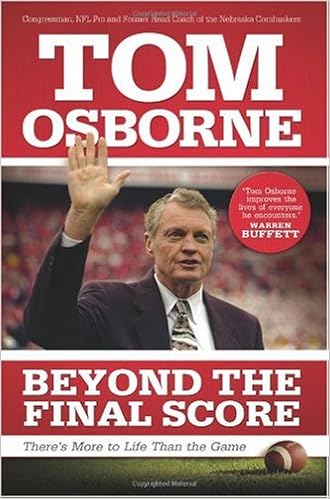


The cover of my review copy of Beyond The Final Score, There's More to Life Than the Game carries a quotation - not seen above - from Warren Buffett, probably the world's most successful investor, stating: "Tom Osborne improves the lives of everyone he encounters."

If Osborne's book has one definable purpose, then that is the purpose it surely serves. This book can improve your life. It has already improved mine, and I am simply reviewing the book.

It is a rare football coach who would begin the first chapter of his book with a quotation by Mark Twain, author of The Adventures of Huckleberry Finn and Tom Sawyer, and known affectionately as the "father" of American literature. Osborne quotes Twain:
"Twenty years from now you will be more disappointed by the things you didn't do than by the ones you did do. So throw off the bowlines. Sail away from the safe harbor. Catch the trade winds in your sails. Explore. Dream. Discover."
Right from the start of Beyond The Final Score, There's More to Life Than the Game, the reader of Osborne's book is thus aware that this is not simply a personal collection of memoirs, but rather a potentially valuable work of wisdom for everyone, written by three-time congressman Osborne, who is not only famous as the former head football coach at Nebraska but is also a respected leadership educator, who at age 72 presently serves as the Athletic Director at the University of Nebraska, Lincoln.

When Tom Osborne (pronounced OZ-burn) retired in 1997 as head football coach of the University of Nebraska Cornhuskers, "Oz" was his own legend, having won at least nine games in every coaching season and having compiled the then best winning percentage among active Division I-A coaches for a 255-49-3 won-loss record. In his last game as Husker head coach in the 1998 FedEx Orange Bowl, the Huskers won the national championship in the coaches poll, beating Tennessee and Peyton Manning, 42-17.

Indeed, Tom Osborne had gotten better as the years went by, winning 60 games and losing only 3 in his last five seasons, while winning three national championships (1994, 1995, and 1997). In fact, ESPN fans in 2006 rated his 1995 Husker team the best college football team of all time. That same Number 1 rank was assigned to the unbeaten 1995 team in 2005 by Sports Illustrated viz. CBS and Sagarin and in 2001 to the football program as a whole by scout.com. An amazing thirty-three of the players on the Husker's 1995 roster went on to play professional or semi-pro football.

ESPN named Osborne coach of the decade in 1999 and an ESPN poll in 2007 voted Osborne the greatest college football coach of all time. Such accolades are of course always subjective, but, whether you agree or disagree, they do reflect a level of achievement that is outstanding.

But how many football or other fans know the true story of how Osborne became a Nebraska assistant coach to begin with. Osborne relates the story in his book Beyond The Final Score, There's More to Life Than the Game (pp. 182-183):
"When I asked Bob Devaney if I could join his coaching staff, he told me that he had no positions open. However, he said that if I wanted to do so, I could move into an undergraduate dorm with seven or eight players who were causing trouble. If I had success with them Bob and I would revisit the possibility of coaching. These guys had developed a kind of frontier mentality: Anyone who trespassed their territory would suffer the consequences. The dorm counselors were afraid of them, and the school's administrators seemed at a loss for how to deal with the problem....

When I wasn't breaking up fights, I made every effort to get to know each one of the guys. Living side by side with them, day in and day out, helped me to build relationships of trust. And that was the key, I think, in helping them turn things around."
Oz was successful and Bob Devaney was proven to be a very wise man.
Oz got the job.

(Note via LawPundit on the unexpected but close connection of academics, football and law: Bob Devaney became NU head coach through a suggestion made to then NU Chancellor Clifford Hardin (later U.S. Secretary of Agriculture) by Michigan State head coach Duffy Daugherty. I went to school with Hardin's children. Cynthia Hardin Milligan is a J.D. and the Dean Emeritus of the Business School at the University of Nebraska, whose husband Robert S. Milligan is the current Chairman of the Board of Directors of the U.S. Chamber of Commerce. Cynthia Hardin Milligan worked together with Tom Osborne at the University of Nebraska on leadership matters. Nancy Hardin Rogers is also a J.D. and is the daughter-in-law of the late former U.S. Attorney General and Secretary of State William P. Rogers. She is herself a former Attorney General of Ohio and past President of the Association of American Law Schools.)

In the same years that Tom Osborne was beginning his football coaching career, I was in my undergraduate student days at the University of Nebraska. One semester I had a very early morning weight-lifting class (7:30 a.m.) in the basement of the University of Nebraska Coliseum in Lincoln (see video), which today houses the very successful Huskers volleyball program, but then was the arena for Cornhusker basketball games.

That same Coliseum today holds the women's sports NCAA record for the most consecutive sellouts, and I always felt good in the classic aura of that building (see video). Indeed, if I arrived early for my weight-lifting class - this was ca. 6:30 a.m. - I would go shoot baskets on the practice basketball floor prior to that class - I had my own ball.

Few people were even awake on campus at that early hour, and I was usually alone, but I did meet one other person there several times shooting baskets just like I was, very early in the morning. He was a tall (6'5") player who had been selected as an All-State basketball player in high school and was voted the Nebraska Athlete of the Year in 1955. His name, Tom Osborne, who was - then - an assistant for the University of Nebraska football team and - today - is in the National Football Foundation Hall of Fame.

As we all know from Benjamin Franklin, philosophy and wisdom aside, success comes through hard work and effort, quoting ushistory.org: "Early to bed and early to rise makes a man healthy, wealthy and wise" and Osborne's day began early. I am sure Osborne does not remember me from those early morning basketball encounters, but they were significant enough for me that I can recall them well. This was BEFORE Osborne became a famous coaching name.

It is interesting to see that good habits, once made, are not easily broken, although they may have to be amended to adapt to a change of circumstances. Osborne specifically refers in his book to the gym as an "oasis from partisanship" during his years as a congressman in Washington D.C., where he "made many friends on both sides of the aisle during my evening trips to the gym ... and ... would often stay until it closed around 10:00 P.M. I've always enjoyed working out, and the friendships that I formed there made it an even better experience." The time(s) had changed, but the good habits had remained. Note that Osborne was quite clearly not a supporter of the type of blind partisanship that often marks our vastly improvable Congress.

We were very much moved by Osborne's discussion in his book of the values of family, mentoring, leadership and serving, especially his conviction that "leadership as service", what Osborne calls "transformational leadership", is the best of all leadership forms, even though it is the most difficult to attain.

Osborne tells us on this leadership topic that:
"How a person leads is greatly influenced by his or her understanding of the world ... worldviews are inextricably tied to leadership.

There are so many interesting things discussed in Osborne's book that no review can do them justice. Beyond the Final Score should be read in full.

Osborne concludes:
"Is success just about winning? Acclaim? Trophies? Wealth? Our personal happiness or satisfaction? I have been blessed to experience some of these over the years, and I can answer without batting an eye: No. Accomplishments, applause, awards and fortune are rewards that often come as the result of hard work and a determined spirit, but there is something bigger. Something better. Something that will outlast the winningest season, the plushest corner office, the heftiest bonus and the loudest cheers. That something can only be found when we look beyond the final score." - Tom Osborne, Beyond The Final Score, There's More to Life Than the Game, p. 17

Saturday, March 21, 2009

The Sport Pundit Wins Men's Golf Club Championship at the Mosel Golf Club in Cochem, Germany : At Age 61 The Secret is Custom Made Cubs

Just for the record, we post here somewhat later than the actual season, the fact that the SportPundit won the 2008 men's golf club championship at the Mosel Golf Club in Cochem, Germany, which was quite an event for this writer given the Sport Pundit's age at the time of winning - 61. (Update: Below is the later-posted official photograph of the Cochem 2008 club champions - from the left - women's, senior men's, youth, senior women's, and, at the far right, the Sport Pundit, the men's club champion - Andis Kaulins).


The Sports Pundit, a long hitter, was aided by the terrible weather on the weekend, with high winds and prolonged rain, which made the course very difficult to play for nearly everyone, especially the shorter hitters. The photo below shows the 575-yard par 5 signature 17th hole at the GolfClub Cochem par 72 championship golf course:


A long and accurate tee shot has to carry a biotope ravine so deep that the fairway can only be reached by going around the biotope on a horseshoe path through woods to the left (that path is not visible in this photograph as taken from the GolfCochem.de website). There is an out-of-bounds to the left about 10 meters from the edge of the fairway, all the way down the fairway to the green, and deep impenetrable rough to the right. A gigantic fairway sand trap (bunker) to the right catches long drives that try to cut the corner too sharply. The fairway slopes uphill all the way to a large elevated green fronted by a sand trap and there is almost always a strong prevailing wind in the player's face, making this hole almost impossible to reach in two, even for the strongest players. The Sport Pundit birdied this hole during the tournament.

The rough can look like this (taken from the GolfCochem.de website):


The 27-hole Mosel Golf Club in Cochem opened nominally for play on October, 2006. This year, in 2008, the course is in good condition for championship play. Especially the greens are already in excellent shape, given their very young age.

The 18-hole par-72 championship Mosel Course as well as the 9-hole Eifel Course were designed by two of Germany's leading golf architects, Christoph Städler and Dirk Decker.


The photograph above is taken from the GolfCochem.de website and shows the green of the 166-yard par 3 11th hole, with the 160-yard par 3 9th hole in the background above it - both severely uphill.

That same hole 11 is shown in the photo below looking down from green to tee, but that is a different sand trap than the sand trap at the right front of the green in the first photo (one can, from the left, also see the 16th green, then part of the 10th green and then the 17th fairway):


Below, the Sport Pundit is shown in a photo (by Hoffman) hitting a sand shot:


The story was reported in the Rhein Zeitung (RZ-Online, 16 September, 2008) and the print version also carried a black-and-white photograph by Hoffman of all of the championship winners [update: that photo is now shown in full in the original color at the top of this page], of which we show only a large scan of yours truly (pardon the garb, which is a fleece jacket with a hood, but we had rain and wind, and we were pretty matted down at the end):


That's golf.

Sky Earth Native America


Sky Earth Native America 1 :
American Indian Rock Art Petroglyphs Pictographs
Cave Paintings Earthworks & Mounds as Land Survey & Astronomy
,
Volume 1, Edition 2, 266 pages, by Andis Kaulins.

  • Sky Earth Native America 2 :
    American Indian Rock Art Petroglyphs Pictographs
    Cave Paintings Earthworks & Mounds as Land Survey & Astronomy
    ,
    Volume 2, Edition 2, 262 pages, by Andis Kaulins.

  • Both volumes have the same cover except for the labels "Volume 1" viz. "Volume 2".
    The image on the cover was created using public domain space photos of Earth from NASA.

    -----

    Both book volumes contain the following basic book description:
    "Alice Cunningham Fletcher observed in her 1902 publication in the American Anthropologist
    that there is ample evidence that some ancient cultures in Native America, e.g. the Pawnee in Nebraska,
    geographically located their villages according to patterns seen in stars of the heavens.
    See Alice C. Fletcher, Star Cult Among the Pawnee--A Preliminary Report,
    American Anthropologist, 4, 730-736, 1902.
    Ralph N. Buckstaff wrote:
    "These Indians recognized the constellations as we do, also the important stars,
    drawing them according to their magnitude.
    The groups were placed with a great deal of thought and care and show long study.
    ... They were keen observers....
    The Pawnee Indians must have had a knowledge of astronomy comparable to that of the early white men."
    See Ralph N. Buckstaff, Stars and Constellations of a Pawnee Sky Map,
    American Anthropologist, Vol. 29, Nr. 2, April-June 1927, pp. 279-285, 1927.
    In our book, we take these observations one level further
    and show that megalithic sites and petroglyphic rock carving and pictographic rock art in Native America,
    together with mounds and earthworks, were made to represent territorial geographic landmarks
    placed according to the stars of the sky using the ready map of the starry sky
    in the hermetic tradition, "as above, so below".
    That mirror image of the heavens on terrestrial land is the "Sky Earth" of Native America,
    whose "rock stars" are the real stars of the heavens, "immortalized" by rock art petroglyphs, pictographs,
    cave paintings, earthworks and mounds of various kinds (stone, earth, shells) on our Earth.
    These landmarks were placed systematically
    in North America, Central America (Meso-America) and South America
    and can to a large degree be reconstructed as the Sky Earth of Native America."